What is Churn?
Churn is what you get when you cross an auto-battler with a game of chess. Eight wizards enter a tournament, each with a tiny army on a 6×6 board. Every round has two halves. First comes the part you control: buying pieces, merging them, choosing where they stand, and playing a few opening moves like a real chess game. Then comes the part you don't: a live battle where every piece fights on its own, striking along the lines it would move in chess.
Wizards who lose battles lose health, and when your health runs out you're out of the tournament. A game usually takes between 8 and 16 minutes, so you can fit one in over a coffee. It runs in any modern browser on desktop, tablet, or phone (in landscape), and you don't need an account to play.
How a round plays
You start with a king and a pawn, and on your first round you choose a rook or a bishop to go with them. After that, every round follows the same four beats:
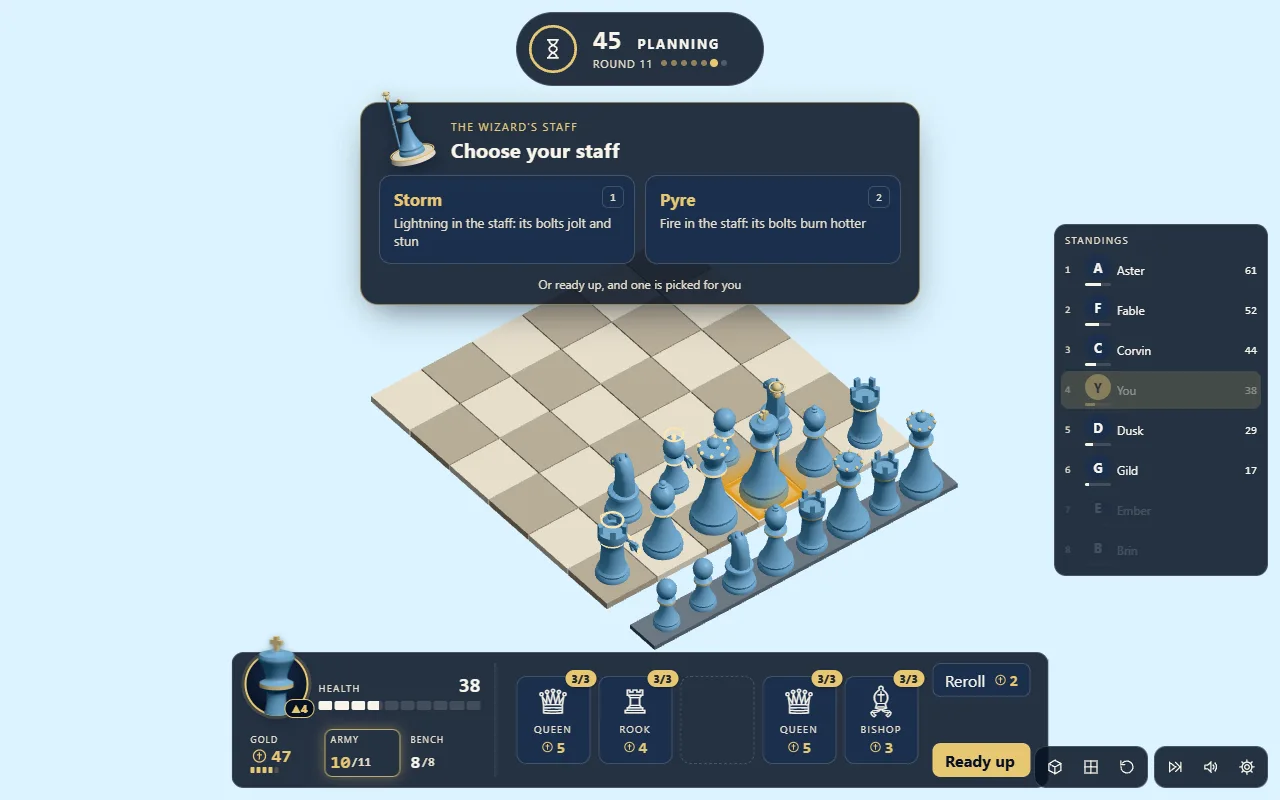
- Planning (30–45 seconds). The shop offers five pieces. Buy what you want, reroll the offers for 2 gold if you don't like them, and arrange your army on your two home ranks.
- Skirmish. You and your opponent play a short chess opening by hand, on 30-second turn timers. Early stages allow 3 moves each and later stages up to 5. The wizard with less health moves first, which gives the player who's behind a small edge.
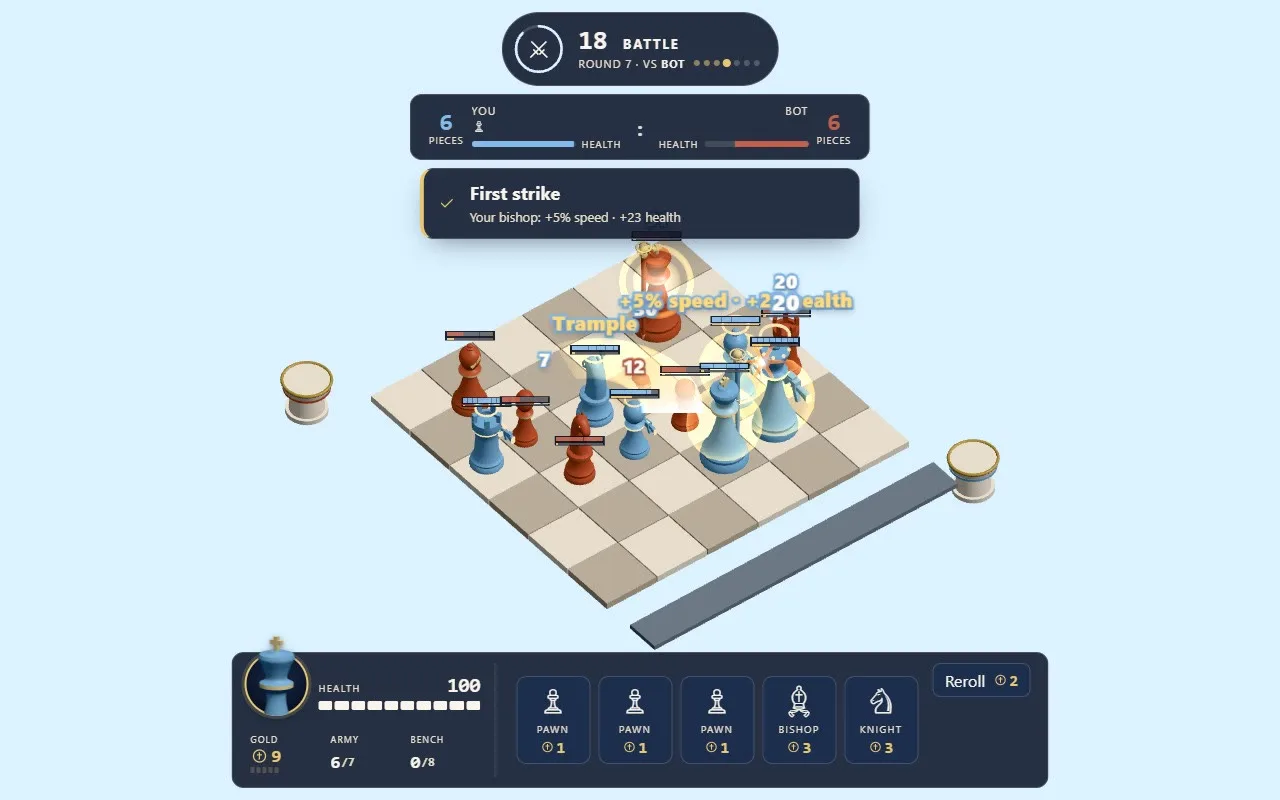
- Battle (20 seconds, then overtime). The pieces take over. Each one attacks along its chess lines and charges up mana for its ultimate. If neither army is wiped out in 20 seconds, overtime starts and speeds up until one is.
- Resolve. The loser takes damage equal to the stage's base damage plus the tiers of the winner's surviving pieces, up to 45 in one hit.
Some rounds aren't against another wizard at all. On checker rounds (rounds 1, 2, 6, 10, and 14, then every fourth round after that), you face a wave of draughts pieces led by a chief. They're a breather, a way to earn gold, and a reminder that checkers pieces have very funny evil faces.
Building your army
Merging
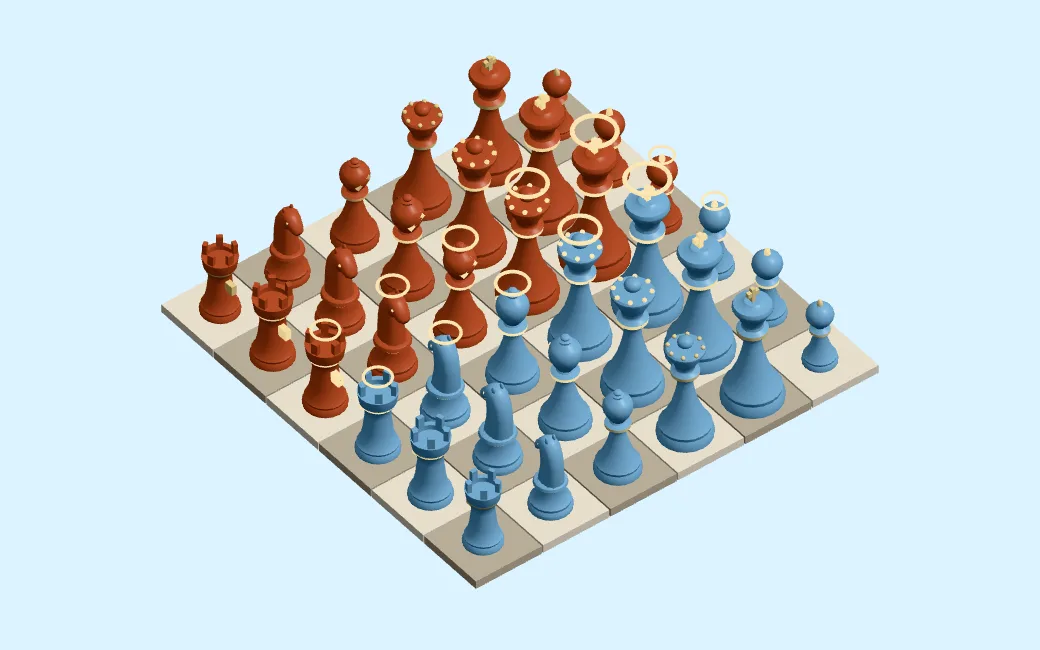
Three copies of the same piece merge into one piece of the next tier, up to tier 3. Higher tiers hit harder and survive longer, and they also count for more when you win, because the damage you deal includes the tiers of your surviving pieces. A tier-3 piece also picks up a signature weapon, listed in the table below.
Branches
When a piece reaches tier 2 you pick one of two branches for it, which changes how it fights. There are ten in all: Phalanx, Vanguard, Trample, Outrider, Blink, Sanctify, Siege, Bulwark, Tempest, and Regent. From stage 5, your king also picks an element for its staff: Storm, whose bolts jolt and stun, or Pyre, whose bolts burn hotter.
Pieces, ultimates, and weapons
| Piece | Ultimate | Tier-3 weapon |
|---|---|---|
| Pawn | Shield Wall | Shotgun |
| Knight | Lance Charge: a golden rider charges through | Warhammer |
| Bishop | Blazing Dash | M16 |
| Rook | Charged Shot | Sniper |
| Queen | Divine Shield: a golden angel appears | M60 |
| King | Divine Blade: a sweep that resets when it gets a kill | Staff |
Check, and when kings fall
Your king is on the board with everything else, and it matters. If it's taken during the opening, it waits on a pedestal beside the board and comes back stunned for the battle. If a king falls during the battle itself, the side that took it surges. In the game's words: "Your army surges: +50% damage, +50% speed, +50% mana, and a 10% shield." Many battles are decided right there.
Playing with friends
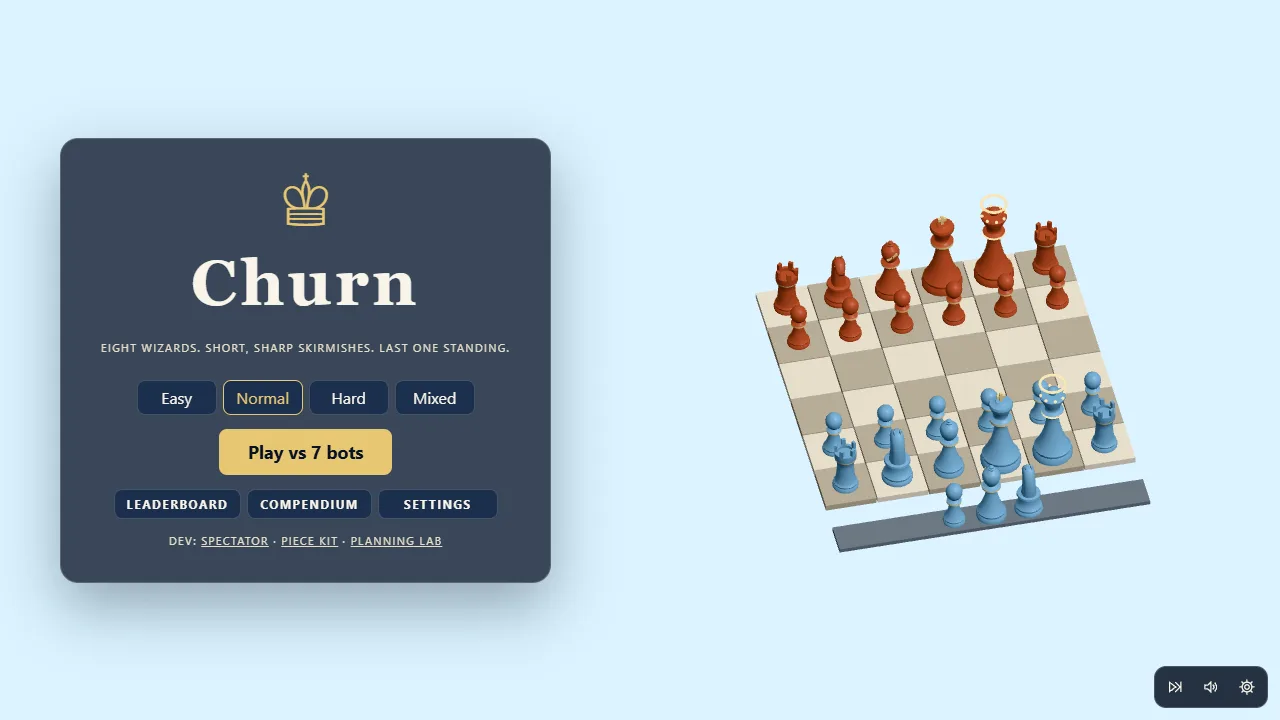
Solo games put you against seven bots on easy, normal, hard, or a mix. To play with people, a host signs in and opens a room, which gets a five-letter code. Anyone with the code can join just by typing a name, with no account needed, and a room holds up to eight wizards. If someone drops out, a bot takes their seat so the tournament can finish. Once you're knocked out, you can keep watching any other wizard's board until the end.
Signing in is optional and uses Google. It's only needed to host rooms or keep a history of your games, and it feeds a public leaderboard that's recalculated every six hours.
Controls
| Action | Mouse and keyboard | Touch |
|---|---|---|
| Place or move a piece | Drag and drop, or click the piece and then the square | Tap, then tap |
| Turn the camera | Drag with the middle mouse button | One-finger drag |
| Zoom | Mouse wheel | Pinch |
| Pick an upgrade | 1 or 2 | Tap the card |
| Settings and pause | Esc | Settings button |
| Mute, or skip the radio track | M, or ` | Sound buttons |
On a phone, turn it sideways: the board needs landscape, and Churn will ask you to rotate if you're holding it upright.
Tips for your first tournament
- Merge early. Three copies make one stronger piece, and tiers add to the damage you deal when you win.
- Treat the opening like chess. A clean capture before the battle starts is a free piece, and leaving a piece hanging hands one to your opponent.
- Guard your king. Losing it in the opening means it comes back stunned, and losing it in battle gives the enemy army a surge.
- Think about your branches. The tier-2 choice is permanent for that piece, and the right one depends on what the rest of your army is doing.
- Being behind isn't over. The wizard with less health moves first in the opening, and checker rounds are a chance to stock up on gold.
How it's made
Churn is written in TypeScript and drawn with Three.js, with every menu built as a Lit web component. There isn't a single 3D model file in the game: every piece is built in code, and all 36 combinations of kind, tier, and side draw in just 13 GPU draw calls. The renderer only draws when something is moving, so an idle board costs nothing.
The rules are a pure, deterministic engine, so a saved game is just the list of decisions that were made, and a replay is that list played back. Solo games run the tournament in a Web Worker in your browser, and each online room runs in its own Cloudflare Durable Object. There are 423 automated tests, and a simulator plays 500 bot tournaments to check that every one finishes cleanly.
Every sound effect is synthesized live. The board's tiles are modeled as struck ceramic plates, tuned to a D major pentatonic scale, so every square has its own note. The parts that would help any game are now being pulled out into Baker Engine, a shared engine for future Baker Games projects.
The in-game radio plays the "Jazzhop LoFi Mix" by Dream Records, licensed under Creative Commons Attribution 4.0.
What's next
Next up are spells (Freeze, Ward, Blink, and Haste), omens that change a whole tournament's rules (Bloodmoon, Narrowing, Ascension, and Stillness), items in the shop, and cosmetic arena sides. New things show up in the devlog first.
Screenshots